

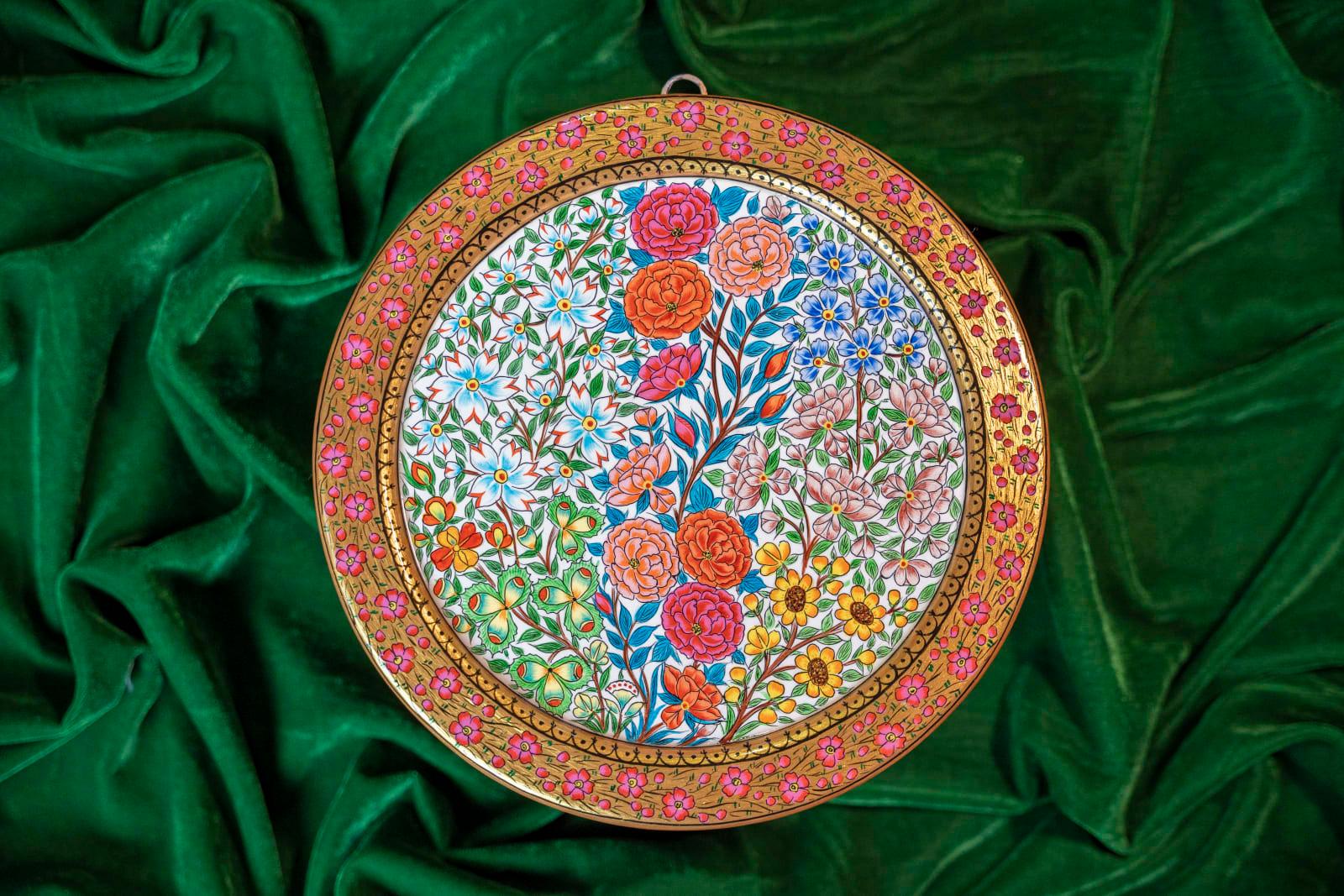
In the old quarters of Srinagar, papier-mâché is still made the way it was centuries ago: by hand, in small family workshops, one layer of paper and one brushstroke at a time. The result is some of the most detailed decorative art made anywhere in India, from jewelry boxes covered in tiny birds to wall plates crowded with flowers.
This guide covers where the craft came from, how a piece is made, what its motifs mean, and how to make sure the piece you buy is the real thing.
A craft that travelled from Persia to Kashmir
Papier-mâché reached Kashmir from Persia and Central Asia in the medieval period. Tradition links its arrival to the 14th-century scholar Mir Sayyid Ali Hamadani, whose followers included many craftsmen, and the craft flourished in the 15th century under Sultan Zain-ul-Abidin, who invited master artisans to the valley.
In Kashmir it became known as kar-i-qalamdani, after the qalamdan, or pen case, one of the first objects the artisans made. Over the centuries, pen cases gave way to boxes, trays, bowls, vases and ornaments.
Today "Kashmir Paper Machie" is a registered Geographical Indication (GI), which recognises it as a craft that belongs to Kashmir and its traditional makers.
How Kashmiri papier-mâché is made
Every piece passes through two sets of hands, and each stage has its own name and its own specialists.
1. Sakhtsazi: shaping the form
The sakhtsaz soaks waste paper in water until it breaks down, pounds it into a pulp and binds it with a natural adhesive. The pulp is pressed over a wooden or clay mould and left to dry, which can take several days. Once dry, the shell is cut free of the mould, joined back together and rubbed smooth.
The surface is then sealed with a coat of chalk mixed with glue, often followed by a layer of fine tissue paper, to give the painter a smooth, even base.
2. Naqashi: painting the design
Next the piece goes to the naqash, the painter. Designs are drawn freehand, and colour is built up in layers with fine brushes: first the background, then the motifs, the outlines and finally the smallest highlights. Traditional colours came from mineral and plant sources, and gold details are added by hand.

A small box can take days to paint, and a densely patterned plate or vase much longer. The finished piece is sealed with several coats of lacquer, which protects the paint and gives papier-mâché its soft sheen.
The motifs and what they mean
Kashmiri designs draw on the valley itself: its trees, flowers and birds.
- The chinar leaf. The chinar, Kashmir's great plane tree, turns red and gold in autumn and is one of the best-loved symbols of the valley.
- Hazara, the "thousand flowers". Blossoms painted edge to edge, so densely that almost no background shows through.
- Birds among branches. Small birds perched in trailing foliage, often on a gold or ivory ground.
- Garden flowers. Roses, irises and lotus, echoing the gardens and lakes Kashmir has long been famous for.

You can see several of these motifs on our hand-painted floral wall plate and across our wall plates.
How to tell authentic Kashmiri papier-mâché from a copy
Because the craft is so recognisable, it is widely imitated, usually with printed designs on resin or plastic passed off as hand-painted work. These six checks will help you spot the difference.
1. Feel the weight
Genuine papier-mâché is surprisingly light for its size. A papier-mâché piece that feels heavy is likely resin or ceramic underneath. Naqashi on wood, like our jewellery boxes, is a separate tradition, and wood is its natural base.
2. Look closely at the brushwork
Hand painting leaves tiny variations: strokes that taper, petals that aren't quite identical, colour that sits slightly raised on the surface. Printed decoration looks flat, and under a magnifying glass it often shows a pattern of dots.
3. Compare repeated motifs
On a hand-painted piece, no two birds or flowers are exactly the same. Perfectly identical repeats suggest a print or a transfer.
4. Check the edges and the inside
Well-made pieces are finished everywhere, including the rims, joins and interiors. Rough plastic seams or unfinished insides are warning signs.
5. Think about the price
A painted plate or box represents days of skilled work. A "papier-mâché" piece priced like a mass-produced souvenir usually isn't handmade.
6. Ask where it was made
Buy from makers who can tell you who made a piece and where. Every Layli piece is made in Srinagar and comes with a certificate of authenticity.
Caring for papier-mâché
With a little care, a papier-mâché piece lasts for generations.
- Dust with a soft, dry cloth. Never wash it or wipe it with a wet cloth.
- Keep it out of long periods of direct sunlight, which can fade the colours.
- Avoid damp places such as bathrooms.
- Use vases for dried flowers, or put a glass insert inside for fresh ones. Never pour water straight in.
Bring a piece of Kashmir home
Every Layli piece is shaped and painted by artisans in Srinagar, in a family workshop that has practised the craft since 1900. Browse our jewelry boxes, vases and wall plates, or read our story.