

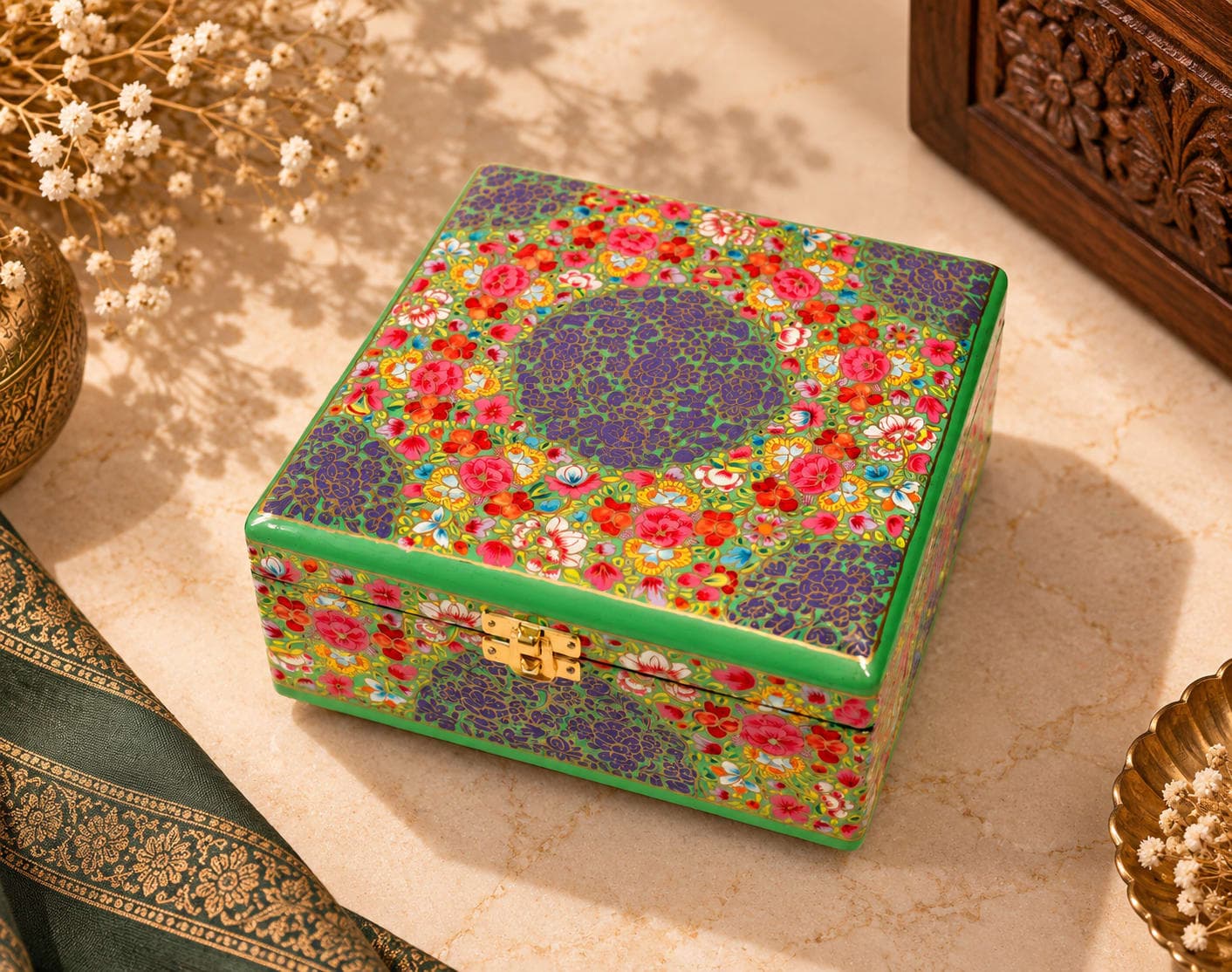
Something remarkable has happened in the last few years. You can ask an AI to design a pattern, write a poem, plan a menu or paint a picture in the style of a Mughal miniature, and it will do it in seconds. A factory can print that picture onto a box, a mug or a cushion before lunch. Almost anything can now be made faster, cheaper and in greater numbers than ever before.
And yet, the more things become instant, the more people look for the opposite: objects that took a long time, made by someone whose name you can know. When almost everything can be produced on demand, what becomes rare is human time and skill. Rarity has always been the real meaning of luxury, which is why handmade has quietly become the new luxury.
What AI can make in seconds, and what it can't
AI is extraordinary at producing images, text and designs. Describe a floral Kashmiri motif and it will return a convincing picture before you finish your tea. Combined with modern printing, that picture can appear on thousands of products by the end of the week.
What it cannot do is hold a brush. It cannot lay down a base coat, wait for it to dry, and then paint petal after petal with a fine brush, correcting by eye as the light changes. It cannot give a piece the tiny variations that show a person made it: a leaf that curls a little differently, a line that thickens where the hand paused. Those small differences are not flaws. They are the proof.
Why handmade has become a luxury
Time has become the scarcest material
At Layli, a hand-painted piece takes an average of 48 hours of work, and a single vase can pass through four pairs of hands over about four weeks. No software update makes that faster. In a world that optimises everything for speed, an object that simply took as long as it needed has become precious.
No two pieces are the same
A printed design is identical every time; that is the point of printing. A hand-painted box is one of a kind. Even when an artisan paints the same motif twice, the flowers fall a little differently and the gold catches the light in its own way. Owning something that exists only once is a quiet kind of luxury that mass production cannot offer.
A story you can trace back to a person
Luxury used to mean a famous label. Increasingly, it means knowing who made something, and how. We name the artisans behind our pieces: master artisan Maqbool Hussain Kashoo, who paints our naqashi jewellery boxes, has spent 45 years at the bench. An AI-generated product has no maker to name.
Made to be kept, not replaced
Handmade pieces are made to last. Papier-mâché and naqashi on wood are sealed with coats of lacquer that protect the painting for years, and a well-kept piece becomes something to pass on rather than throw away. Buying fewer, better things is also one of the most sustainable choices most of us can make.
"Handmade" is easier to fake than ever
The same technology that makes design effortless has made imitation effortless too. AI can generate photographs of products that were never made, and printed designs are often sold as hand-painted work. If you are paying for craft, it is worth checking that you are getting it:
- Look for small irregularities. Brushstrokes vary in thickness and direction. Print is perfectly uniform, and a magnifying glass often shows its tiny dot pattern.
- Feel the surface. Hand-painted work often has a slight texture where paint and gold sit on top.
- Ask who made it. A genuine maker or seller can tell you the artisan's name, where the piece was made and how long it took.
- Ask for a certificate of authenticity. Every Layli piece comes with one.
For Kashmiri craft in particular, read our guide on how to spot authentic Kashmiri papier-mâché.
Centuries of slow craft in Kashmir
Kashmir's papier-mâché and naqashi traditions have been passed down through families for generations, and the process has barely changed. Paper is soaked and pounded into pulp, shaped and dried (sakhtsazi), smoothed and primed, then painted by hand (naqashi) with motifs such as chinar leaves, flowering vines and birds, and finally sealed with lacquer. Naqashi is also painted on wood, which is how our jewellery boxes are made.
These are not techniques that can be automated without losing what makes them valuable. The value is in the hours, the judgement and the hand.
How to choose handmade pieces worth keeping
- Buy for a place, not a trend. Choose something you can picture on a particular shelf or dressing table for years.
- Look closely at the detail. Fine, even brushwork and clean gold outlines are signs of an experienced hand.
- Think about who it is for. A handmade piece is a gift with a story, which is why it works so well for weddings, housewarmings and corporate gifts.
- Care for it simply. Keep it away from water and strong direct sunlight, and dust it with a soft, dry cloth.
Our papier-mâché gift guide has ideas for every occasion, and our corporate gifting page covers orders for teams and clients.
Can AI and handmade craft coexist?
They already do. Technology helps small workshops reach people far beyond their own street: a website lets us send pieces from our studio in Srinagar to homes across India and abroad. What technology should not do is replace the hand itself, or pass off a printed copy as the real thing. The more ordinary things AI makes, the more a genuinely handmade object will stand out.
Frequently asked questions
Why are handmade products more expensive?
Because you are paying for skilled human time. A hand-painted piece can take days of work by an experienced artisan, where a printed one takes seconds, and every handmade piece is unique.
Is handmade better than machine-made?
For everyday, disposable items, machine-made is often fine. For pieces you want to keep, give or pass on, handmade offers individuality, a traceable origin and a finish that printing cannot match.
Will AI replace artisans?
AI can imitate how a design looks, but it cannot make a physical object by hand. As machine-made and AI-generated goods become more common, genuinely handmade work is becoming rarer and more valued, not less.
How do I know a Layli piece is handmade?
Every piece is painted by hand by an artisan in Kashmir and comes with a certificate of authenticity. You can meet the people behind the work on our About page.
Explore our hand-painted collection, from jewellery boxes to wall plates, each one made slowly, by hand, in Srinagar.